
Real-Time Multilingual Support: What the Pipeline Actually Has to Handle
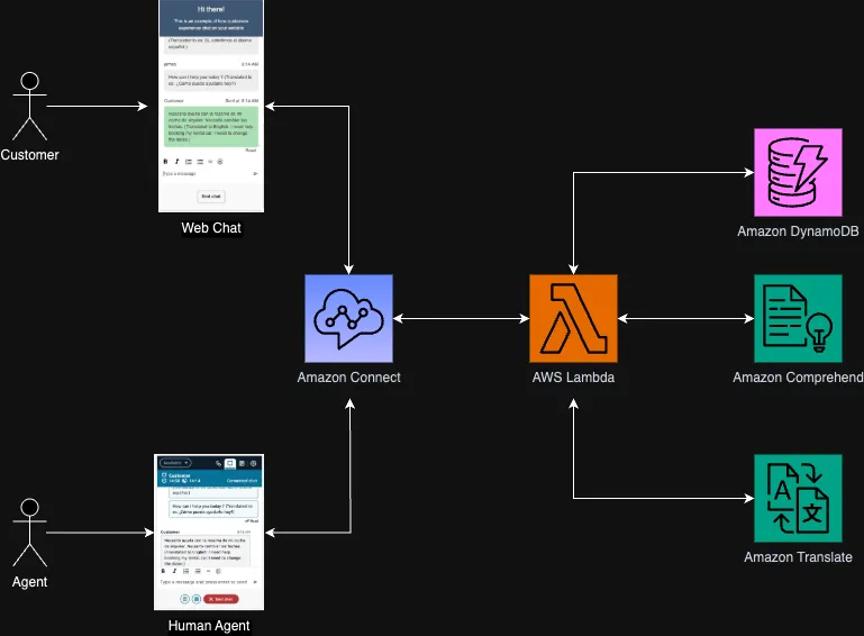
Every article about multilingual support opens with the same sentence: the customer writes in their language, the agent reads it in theirs, and the conversation continues. That description skips the part that actually decides whether the operation works, which is the roughly two seconds between those two states.
A recent AWS post on real-time multilingual chat processing in Amazon Connect describes the shape of that pipeline: detect the incoming language, translate the message, route it to someone who can work in it, and keep the original next to the translation so nothing is lost. It is worth reading for a reason other than the product pitch. It makes explicit the four decisions any team attempting live translation has to make, whether it builds the thing or buys it.
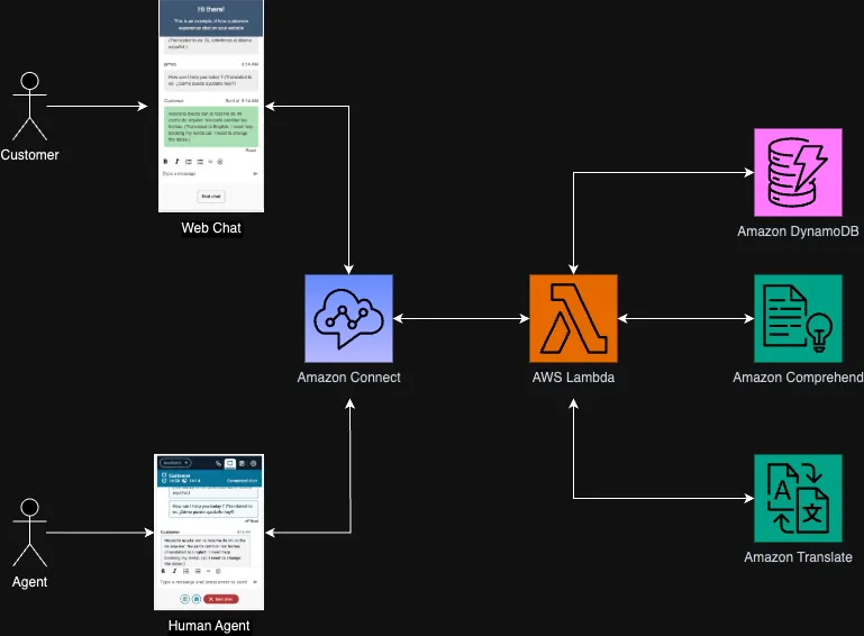
Detection is the easy part, and also the part that lies to you
Language identification on a single clean sentence is close to solved. Real support traffic is not a single clean sentence. A Portuguese buyer writing to a supplier in the morning will write English for the technical part and switch mid-message. A German customer will quote a price back in the seller's own currency formatting. A Thai user will drop a product link with no prose at all.
Every detector has a confidence threshold, and where you set it determines what happens at the margin. Set it high and you route confidently, but messages below the line sit unassigned until a human corrects them. Set it low and you get confident misroutes — a Spanish sentence handed to a Portuguese speaker, who reads it perfectly well, because the two are close enough that the mistake stays invisible until the customer objects.
The number worth tracking is not the overall accuracy rate. It is the rate at which a route gets corrected after assignment. That number tells you whether your threshold and your staffing actually agree with each other.
The latency budget is a product decision, not an engineering one
Live translation adds a delay that the customer experiences directly. The engineering question is how much delay the pipeline can absorb. The product question is how much delay a customer will tolerate before concluding that nobody is there.
These are not the same question, and most teams only discover the second one after launch. In asynchronous channels — email, ticket queues, messages sent outside business hours — a fifteen-second translation delay is invisible, because the reply was going to take minutes anyway. In a live chat window, the same delay reads as an outage. The customer has typed, the typing indicator has stopped, and nothing has come back. They send a second message, and then a third.
So the latency target has to be set per channel rather than per product. And it has to be measured end to end, including the queue wait, not just the translation call. A translation that takes 400 milliseconds is not the customer-facing response time if the message then waits ninety seconds for an available agent.
Keep the original, or you have thrown away the audit trail
The most consequential design choice in these systems is unglamorous: whether the original message is retained alongside the translation.
Translated-only storage is cheaper and cleaner, and it is how most implementations start. It is also how disputes become unresolvable. When a customer says you promised a delivery date, and the stored text says something subtly different from what you read at the time, there is no way to settle it. Retaining the original costs storage and creates a data-handling obligation. Both are cheaper than discovering, six months later, that your only record of a commitment is a translation you cannot re-derive.
This matters for quality work too. You cannot audit translation output if you have thrown away the input.
Escalation has to be defined before the pipeline ships
Live translation is most valuable in first contact and least reliable in last contact. A pricing negotiation, a defect claim, a contractual dispute — these are exactly the conversations where a subtly wrong word is expensive, and exactly the ones where an agent needs to escalate rather than improvise in a second language.
The failure mode is having no defined threshold. The agent decides whether they can continue, individually, and that decision depends on how tired they are and how the conversation is going. Define it as a rule instead: named categories of message that always escalate, a named person who receives them, and a time window in which they receive them.
What this looks like in practice
For a team of five handling customer chat across three time zones, the realistic version of this pipeline is unglamorous and worth doing anyway:
- Detect the language, and store the confidence alongside the message. Low confidence goes to a human, not to a guess.
- Set response targets per language per time zone, not one global number.
- Keep both strings, and make sure whoever escalates can see both.
- Write down which message types always escalate, before the first one does.
None of this requires a particular translation platform. It requires the decision to be made deliberately. The tools change; the four questions do not.
Related reading: evaluating a multilingual support platform covers the vendor-selection questions, a queue that reads the language covers routing mechanics, and the tone problem in real-time translation covers what machines still get wrong after the words are correct.
Source note: This article draws on the AWS post "Breaking Language Barriers: Real-Time Multilingual Support with Amazon Connect Chat Message Processing" (https://aws.amazon.com/cn/blogs/contact-center/breaking-language-barriers-real-time-multilingual-support-with-amazon-connect-chat-message-processing/), which describes a multilingual chat processing pipeline. The four-decision framing, the latency analysis, and the escalation guidance are our own operational analysis. No performance figures from the source are used as verified data here.


